
Read Greene County Property Tax Records
A Greene County tax record tells two stories: the value assigned for assessment and the bill produced after rates and relief are applied. Mark Holder serves as Tax Assessor, while the Collector handles collection duties and the annual sale.
| Field | What It Shows | Where |
|---|---|---|
| True or market value | County estimate of full value | Assessor roll |
| Assessed value | Value after state ratio | Assessor roll |
| Exemption | Approved relief | Assessor record |
| Bill and status | Year, charge, and payment data | Delta tax |
| District | Taxing jurisdictions | Tax roll and GIS |
Mississippi applies a class ratio and then millage. Class I owner-occupied residential real property is assessed at 10 percent, Classes II and III at 15 percent, and Classes IV and V at 30 percent. Tax value is not a sale appraisal.
Use Greene County's Delta Tax Fields
The Delta tax form accepts a name, an address, a parcel number, a PPIN, or a section, township, and range, with no required field and no public year selector. Any single field can start a query.
| Field | Limit | Best use |
|---|---|---|
| Name | 35 | Party accounts |
| Address | 6 / 30 | Known site |
| Parcel | 20 | Exact property |
| Section / township / range | 2 / 3 / 3 | Rural land |
| PPIN | 6 | System match |
Delta calls its uploads frequent, though records can lag behind work finished at the courthouse, so the posting date on any result matters. Save the tax year too.
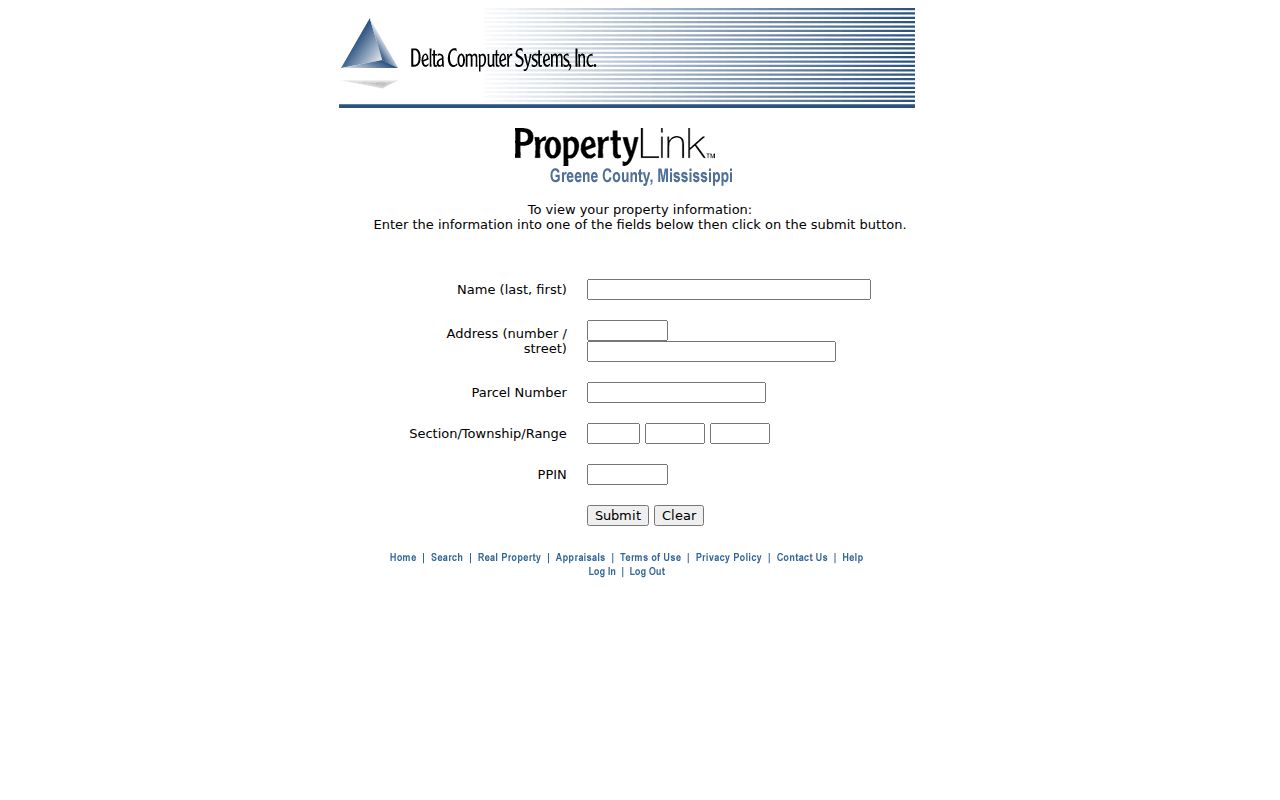
Legal-location fields make the form useful for rural tracts.
Separate Greene Appraisal and Collection Roles
The county office page divides the work. The Assessor locates, classifies, and assesses property, maintains ownership maps, supports values, and presents rolls to the supervisors. The Collector receives real, personal, mobile-home, and automobile taxes. Use appraisal data for class and value. Use the tax record for the bill, and match the newest deed to a recent transfer with the same parcel or PPIN throughout.
Follow Greene County's Tax Calendar
At least half of a Greene County bill is due by February 1 after the tax year. Later installments draw one percent monthly interest. The roll opens by July 15. Valuation appeals go to the Board of Supervisors on the first Monday of August. GIS marks its display effective year 2026. No revaluation year is confirmed, so verify the current notice before acting.
Look Up a Greene County Tax Bill
Keep one parcel or PPIN through each step, noting only the fields a live tax bill result actually returns in Greene County.
- Search Delta by address, parcel, PPIN, owner, or legal location.
- Record the tax year, values, district, amount, and status shown.
- Compare the appraisal result for class and exemption.
- Ask the Collector to confirm delinquency, lien, or sale status.
- Assessed value
- The ratio-adjusted value used in tax calculations.
- Millage
- The rate applied to assessed value.
- Homestead exemption
- Approved relief tied to qualifying occupancy.
- Tax lien
- A claim arising from unpaid tax.
File Greene County Homestead Materials on Time
January 1 occupancy controls. The Greene County homestead filing deadline is April 1. The county checklist asks for the deed or closing papers and identification, plus added proof based on the application. A prior exemption never follows a sale. State homestead guidance adds context, but the Greene County Assessor processes the local filing. Call 601-394-2378 if the roll name or address differs from the application papers.
Trace Delinquent Greene Property and Tax Sales
Unpaid real estate taxes trigger an annual sale. The Collector must advertise it each year, covering delinquent taxes and special assessments. Chancery keeps the paper trail. Its instrument list includes County Tax Sale, County Tax Deed, Tax Sale Release, Tax Deed Set Aside, and Voided Tax Sale. Read later orders before trusting early entries. No current tax-sale list appears online. Ask the Collector for the current notice and Chancery for the recorded instruments; the state retention schedule names tax-sale publication and redemption series but cannot promise that any specific item survives online.
Request Greene County Tax Records Offline
Both offices share one address. Use PO Box 477, Leakesville, MS 39451, or call 601-394-2378. Weekday hours run 8:00 to 5:00, holidays excluded. One vendor contact block carries a ZIP typo, so pull the mailing ZIP from the county office page instead. Put the request in writing. Give the year, parcel, PPIN, situs, owner, and document. Mississippi Public Records Act guidance covers inspection, actual costs, exemptions, and written denials, and it gives certain individual tax information separate statutory treatment.
Cross-Check Greene Tax District and Parcel Geography
The county ArcGIS parcel layer packs in detail. Fields can hold CITY, STATE, district text, section, township, range, subdivision number, parcel ID, PPIN, acreage, street data, and owner mailing data when populated. Those attributes explain the jurisdictions on a Greene County property tax record. They will not calculate the final bill. Nor can a GIS layer prove a legal boundary.
State Line needs extra care. The town sits in both Greene and Wayne counties. A State Line mailing address or utility hook-up proves nothing about which county assesses the parcel. Locate the polygon first. Then confirm the county and use that county's assessor and collector. Leakesville and McLain deserve the same caution. Check city wording against parcel geometry and the tax district rather than a ZIP label.
The Tri-State GIS landing page marks its display effective year 2026. That date describes the map and assessment display, not a verified revaluation year, a deed-posting date, or a promise that every current transfer has reached the parcel layer.
Document a Greene County Tax Review
Save what the live tax record shows. Capture the query date, tax year, owner spelling, situs, parcel number, PPIN, class, true or market value, assessed value, exemption, district, bill amount, and status. A screenshot without the tax year can mislead. A later roll or payment can shift the result. Next, compare the saved tax result with the appraisal record and the newest recorded conveyance, since each answers a different question. The appraisal roll may lag a recent deed. The deed itself will not show whether this year's bill was paid. Preserve any tax sale, redemption, or release notice. Save the matching Chancery recording as well, because this dated trail lets the Tax Collector confirm a mismatch without repeating an open-ended search.
Challenge a Greene County Assessment
Check the roll by July 15. Compare parcel facts and classification with care. Concrete evidence persuades the Assessor far better than a tax-bill comparison alone, so bring a deed, corrected acreage, improvement facts, photographs, and comparable data tied to the valuation date.
Appeal window. Greene County publishes the first Monday of August for Board of Supervisors valuation appeals. Confirm the current calendar.
An assessment appeal settles value questions only. Deed validity and boundary disputes belong in land, court, and survey records instead.
Keep the whole file together. Include the valuation date, property class, land and improvement facts, acreage, exemption status, and the source of your comparable evidence. A recent purchase adds context. It does not automatically control the statutory assessment, though. A neighbor's bill may rest on a different class, exemption, district, improvement mix, or valuation date.
Spot any factual error before the hearing starts. Compare the deed and legal description, parcel geometry, situs and mailing address, building facts, and district fields. Ask which record supports the challenged item. Retain the response you get. This separates a correctable parcel fact from a value dispute and gives the Board a clear record of what was raised on time.
The bill, roll, and deed answer distinct questions. The bill shows one year's charge and payment record. The roll supplies classification and assessed facts, while the deed supplies the recorded transfer. Match them by parcel or PPIN rather than by name or street. When a sale or closing depends on status, ask the Collector to certify it.
Greene County publishes no current online tax-sale parcel list. When delinquency matters, request the current advertisement or sale material from the Collector, and search Chancery for any later tax deed, redemption, release, set-aside, or voided-sale instrument before treating an older status as final.